
Last updated September 10, 2026
Full 25-point door and opener safety check with every visit - springs, cables, rollers, tracks, and your LiftMaster or Chamberlain opener included
You get a price before we start. It does not change when the truck arrives.
 Before
 After
After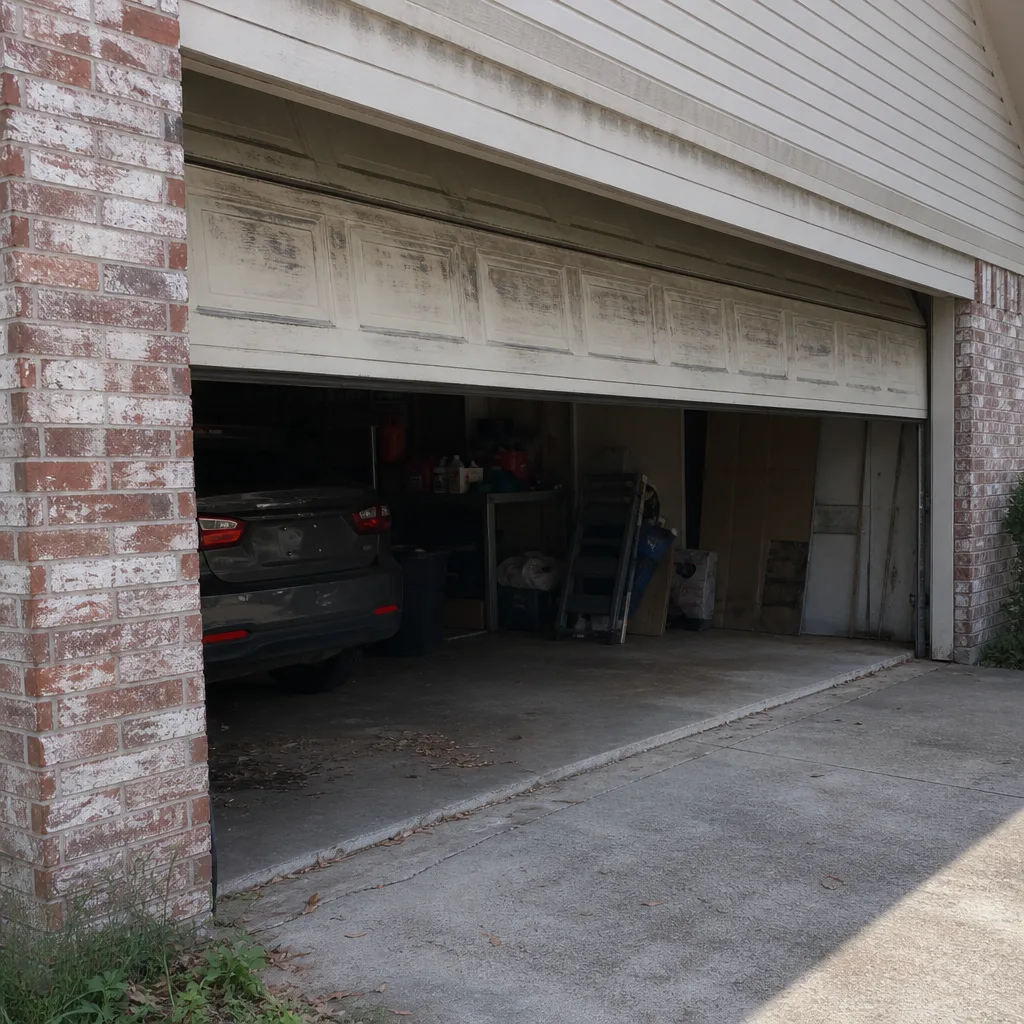 Before
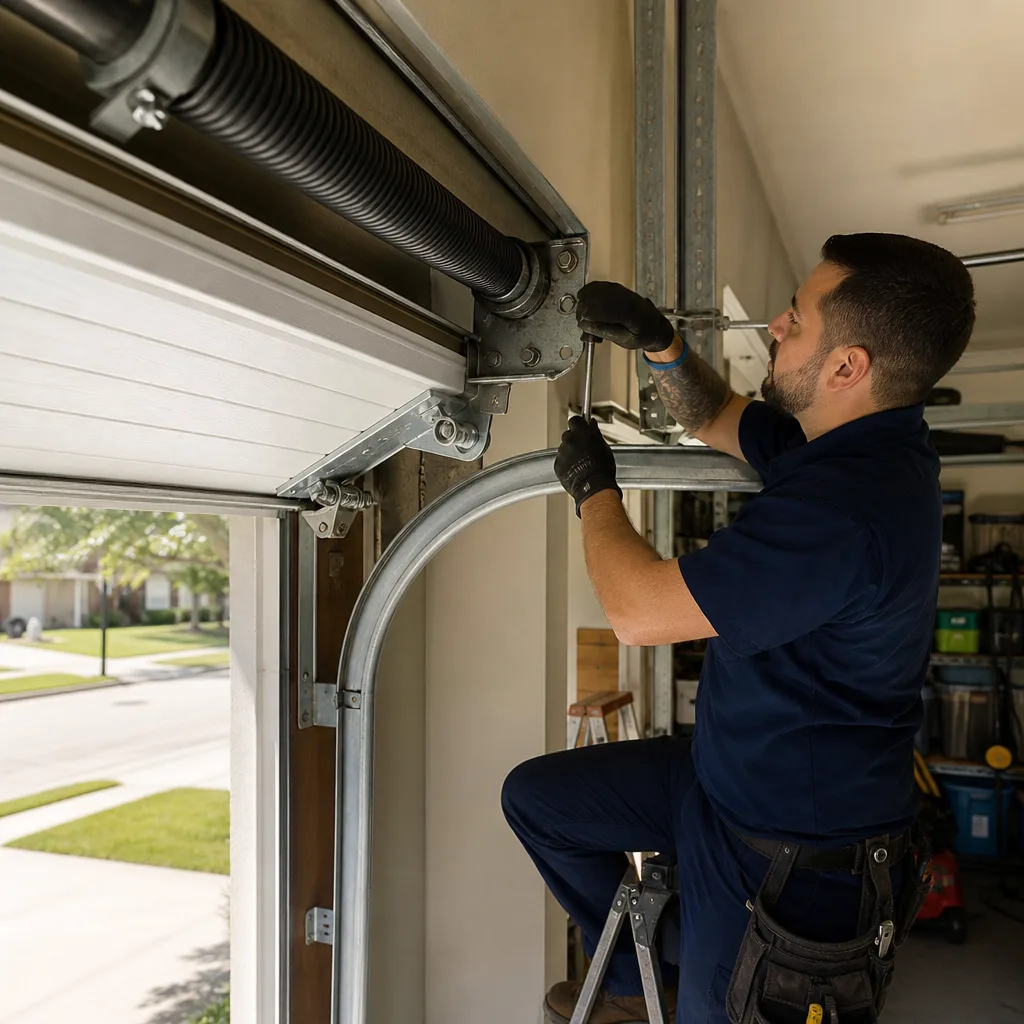 After
After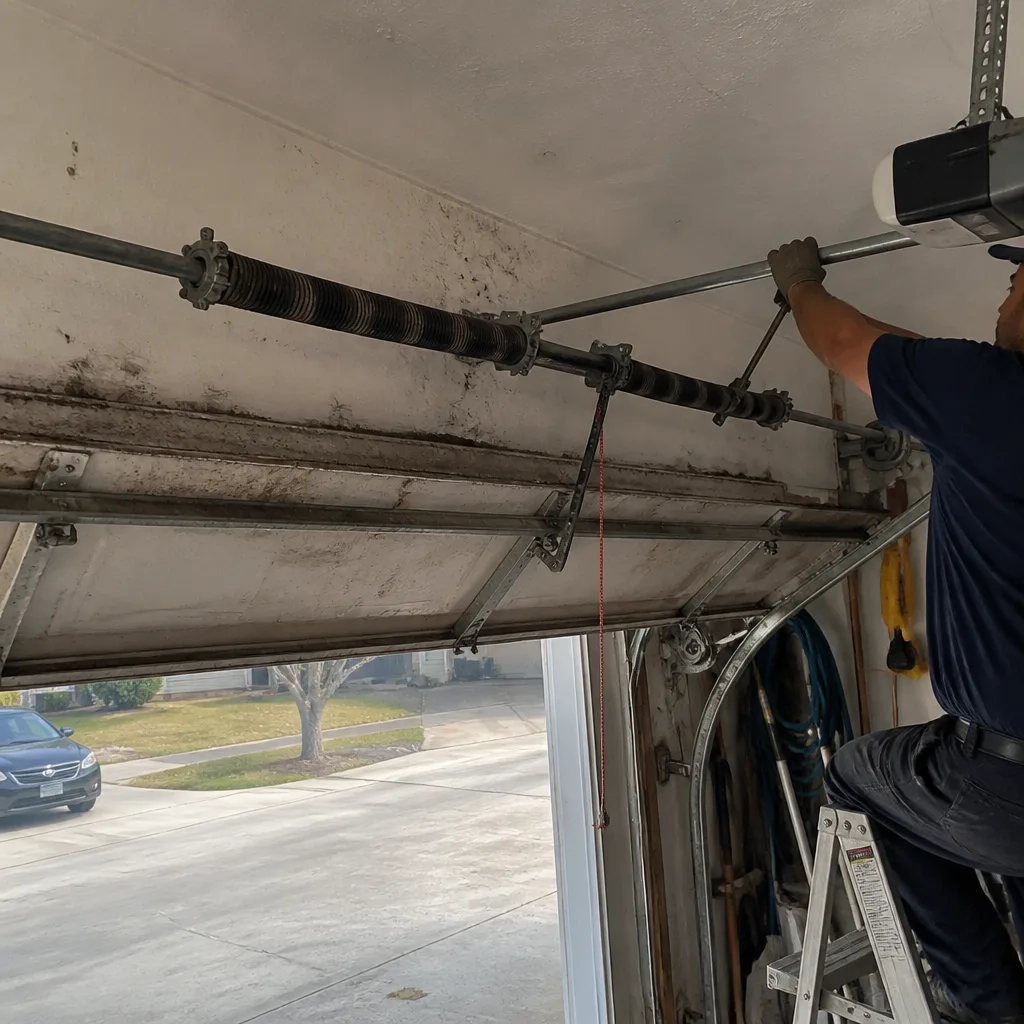 Before
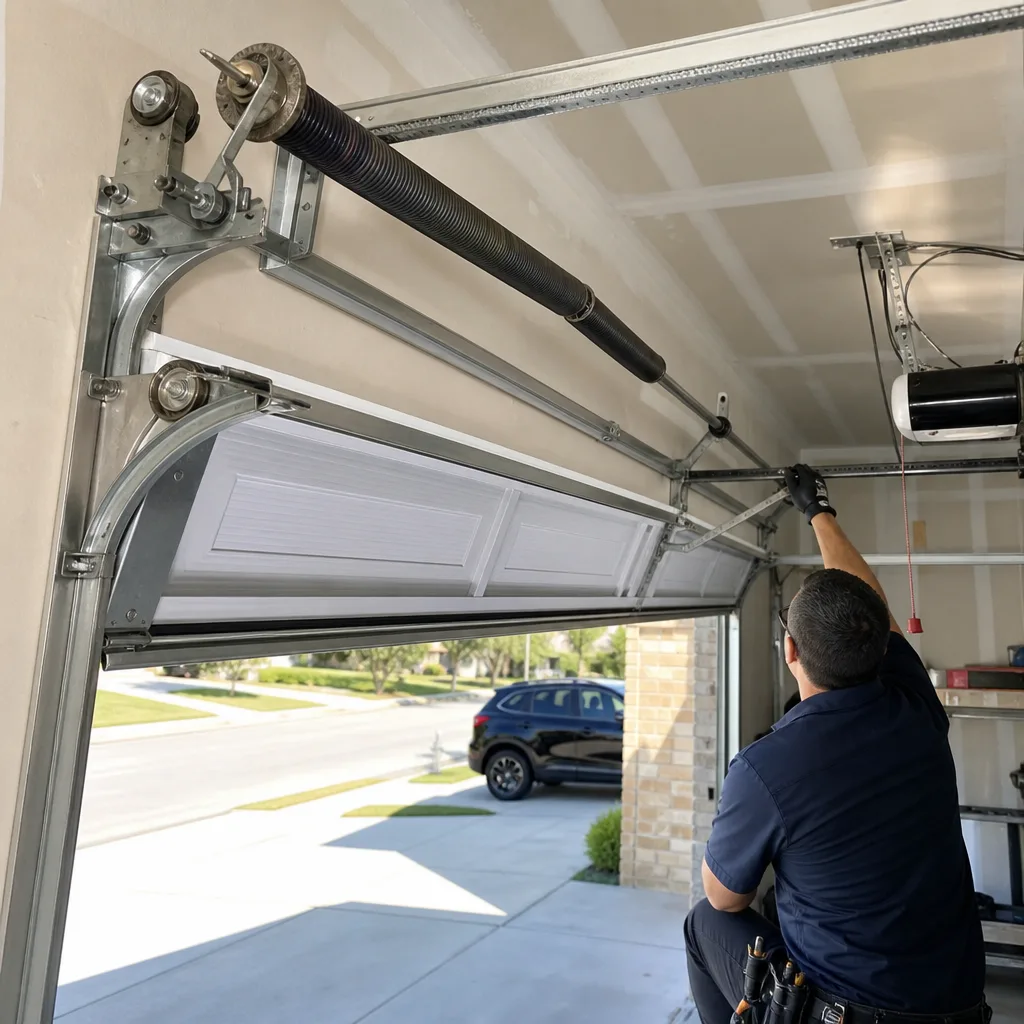 After
AfterHow to Hire a Garage Door Contractor in Liberty: A Step-by-Step Guide
Here’s a number that should make every homeowner in Liberty pause: a standard residential garage door weighs between 130 and 200 pounds, and the torsion springs that lift it are wound tight enough to take a finger off if handled wrong. Yet most people spend more time picking a pizza place than vetting the person who will work on that door. After the last major wind event that tore through Liberty County, at least a dozen out-of-state door crews swept in, worked for two weeks, and then disappeared back across state lines. Three of Otto’s first calls the following month were homeowners trying to track down warranty work from companies that no longer existed in Texas. This guide and our Complete Guide to Garage Door in Liberty give homeowners a concrete screening process that filters for accountability, not just price. You’ll learn exactly what to ask before you book, what a real written estimate must include, how to verify a Texas contractor license in under two minutes, and why the lowest bid you receive is often the most expensive one you’ll accept.
Quick Answer
To hire a garage door contractor in Liberty, TX, verify their Texas license on the TDLR website, confirm they have a local physical address inside Liberty County, require a written estimate that specifies parts, labor, spring grade, and warranty terms before any work begins, and insist the price quoted on the phone is the price you pay at the door. Choose a locally owned, owner-operated shop with a published license number and a real-person warranty, not a franchise dispatch routed through a call center three states away. Otto’s Garage Door has served Liberty since 2004 and answers the phone with a live person, 24/7, at (346) 496-4718.
Table of Contents
- The Five-Question Screening Process: What to Ask Before You Book
- How to Verify a Texas Contractor License in Under Two Minutes
- What a Real Written Estimate Must Include Versus What a Ballpark Quote Is Worth
- Post-Storm Contractor Red Flags in Small Texas Markets
- How to Read an Installer’s Warranty So You Know Who to Call
- Why the Lowest Bid in Liberty Often Costs You More
- Local Accountability: The Difference Between an Owner-Operator and a Franchise Dispatch
- The Complete Hiring Process: From First Call to Final Walkthrough
The Five-Question Screening Process: What to Ask Before You Book
Most homeowners start with one question: how much? That’s the wrong place to begin. Price tells you almost nothing about whether the person standing in your driveway will still be reachable in sixty days when the spring they installed fails. In Liberty, where a good portion of the work comes after storms and the roads between towns are long, accountability matters more than the dollar figure on the invoice. Here are the five questions you ask before you ever agree to a visit.
- “Can I have your Texas license number and your physical business address?” A licensed contractor answers without hesitation. An unlicensed operator stumbles, offers a PO box, or changes the subject. Otto’s published address is in Liberty County, and the license number is on the website for anyone to check before the truck arrives.
- “Who answers the phone at nine o’clock at night?” Garage doors do not fail on a schedule. Springs snap at 9 PM on a Tuesday when your vehicle is sealed inside. If the answer is “a call center” or “leave a message and someone will get back to you,” you are not hiring a contractor. You are hiring an answering machine. Otto answers his own phone around the clock, quotes the job on that call, and holds the number when he gets there.
- “Will the price change between the phone and the driveway?” This is the question that separates owner-operators from bait-and-switch operations. The answer must be no, in writing. The most common complaint Otto hears from new customers is that a national outfit quoted 189 dollars on the phone and presented a 480 dollar invoice at the door. Upfront pricing means the quote is the price, period.
- “What brand of springs and cables do you install, and what’s the cycle rating?” A garage door spring is rated in cycles, not years. A 10,000-cycle spring on a door that opens four times a day lasts roughly seven years. A 5,000-cycle spring lasts half that. Contractors who cannot answer this question are installing whatever is cheapest on the shelf, and you will pay for that decision twice.
- “Can I call the owner directly if something goes wrong?” This is the most important question, and it is the one almost nobody asks. If the answer is “call the warranty department,” you have already lost. In Liberty, the best warranty in the world is worthless if the person who signed the invoice cannot be reached. Otto’s 90-Day Done Right Promise is written on every invoice: if it is not done right, one call brings Otto back, no runaround.
How to Verify a Texas Contractor License in Under Two Minutes
Texas does not require a general contractor license for every trade, but garage door work falls under the Texas Department of Licensing and Regulation (TDLR) when it involves installation and repair of residential doors and openers. The state maintains a public database that any homeowner can search. Here is the exact process, step by step.
- Go to the TDLR website and find the licensee search page. The direct URL is tdlr.texas.gov. It works on a phone browser, so you can do this while the contractor is still on the other end of the call.
- Enter the business name or the individual’s name. A legitimate operator will have registered under the business name they advertise. If nothing comes up under the name on the truck, that is your first red flag.
- Check the license status. The database shows active, expired, suspended, or inactive status. You want active. Anything else and the person you are talking to does not currently hold a valid license.
- Verify the business address matches. The address on the TDLR record should match the address the contractor gave you. If the license shows a Houston address and the contractor told you they are local to Liberty, that discrepancy matters. You want someone whose license is tied to a physical location in Liberty County, not a virtual office.
- Confirm the insurance and bonding status. TDLR requires proof of insurance for licensed contractors. If the database shows the license is active but the contractor cannot produce a certificate of insurance with a policy number, walk away.
The entire process takes less than two minutes once you know where to look. Otto has had his license published for years, and every customer who asks gets the number before the visit, not after. That is the point of a license: it is a public promise that the state has verified the person doing the work. A contractor who hides it is already telling you something important.
What a Real Written Estimate Must Include Versus What a Ballpark Quote Is Worth
A ballpark quote is legally worth exactly nothing. It is a warm feeling, a number tossed out to get you off the phone, and it carries zero obligation for the contractor to honor it once they see your door. A written estimate is a different animal entirely, but only if it contains the right information. In Liberty, where many homes have non-standard door sizes and older openers, the written estimate is your only protection against a surprise invoice.
Here is what a real written estimate must include:
- Line-item parts pricing with brands named. Not “springs, two” but “10,000-cycle torsion spring, 0.207 wire gauge, pair.” A contractor who will not name the brand of spring or cable they are installing is giving themselves room to substitute a cheaper part after you have committed. Otto works across the major brands including Clopay and Amarr doors with Genie and Chamberlain openers, and every estimate names the exact part going on the door.
- Labor priced separately. If labor is bundled into a single number, you cannot tell what you are actually paying for the person standing in your driveway. Separate labor from parts.
- Warranty terms in writing. The warranty should state the coverage period, what it covers (parts, labor, or both), and who to call if it fails. A verbal “yeah, it’s under warranty” is not a warranty. It is a sentence.
- The total price, tax included. In Liberty, the estimate you agree to should be the invoice you sign. No “unexpected complications,” no “this one needed a special bracket,” no surprises. The price is the price.
- The date and the contractor’s name and license number. A written estimate without these is just a piece of paper. The date establishes when the quote was given, and the license number ties the estimate to a verifiable person.
If you receive an estimate that is missing any of these five elements, ask for a revised version before scheduling any work. A contractor who pushes back on a written estimate is telling you they do not intend to honor it. Get it all in writing, and make sure the person who signs the estimate is the same person whose name is on the license and the van. Otto quotes every job on the initial phone call, and the number he gives you is the number on the invoice. Nothing changes between the phone and the driveway.
Post-Storm Contractor Red Flags in Small Texas Markets
Liberty County sits in a weather zone that gets regular wind events, and every time the skies clear, the out-of-state crews roll in. They set up shop in motel parking lots, run Facebook ads with local phone numbers that forward to call centers, and work fast for cash. Three weeks later, they are gone. When the work fails, as rushed work always does, the homeowner has no one to call. Here are the red flags specific to post-storm contractor surges in small Texas markets.
- High-pressure same-day close tactics. “This price is only good if you sign today” is a sales script, not a construction practice. A legitimate contractor’s price is the same Tuesday as it is Thursday. Pressure is a sign that the person on the other end of the pitch is paid on commission, not on reputation.
- No local physical address. Ask where the shop is. If the answer is vague, a PO box, or a town in Louisiana, you are dealing with a transient operation. In Liberty, the distance between towns means a local address is a promise of return. Otto’s address is published, and the license is on file with TDLR for anyone to verify.
- Cash-only deposits or full payment up front. A deposit of 50 percent or more, especially in cash, is a classic storm-chaser move. They want the money banked before the work is done because they do not plan to be around to collect the rest. A local contractor who expects to see you at the hardware store on Saturday does not need a cash deposit.
- Unmarked trucks and out-of-state plates. The truck should carry the business name, the phone number, and a Texas plate. An unmarked truck with a Louisiana plate can be gone by dawn.
- No proof of Texas license or insurance. Out-of-state crews often hold licenses from other states, which mean nothing in Texas. If they cannot produce a Texas TDLR license and a Texas insurance certificate, do not let them touch your door.
- Refusal to provide recent local references. Every legitimate contractor in Liberty has customers within a twenty-minute drive. If the crew cannot name a single local homeowner who will vouch for them, there is a reason.
The pattern is always the same: show up fast, quote low, work quick, leave town. The homeowners who call Otto afterward are the ones who believed the smooth pitch and the “limited time” price. A door is 200 pounds riding on two springs. Respect it, and respect the person you let work on it.
How to Read an Installer’s Warranty So You Know Who to Call
Warranties are the most unread document in the garage door industry, and the most misunderstood. Homeowners assume a warranty means the installer stands behind the work for the length of the paper. That assumption is wrong in ways that cost real money. Here is how to read the warranty language on any garage door or opener job so you know exactly what you are getting.
- Separate the manufacturer’s warranty from the installer’s warranty. When you buy a Chamberlain or Genie opener, the manufacturer covers defects in the unit itself, typically for the opener motor and parts, but not the labor to remove and replace it. The installer’s warranty is a separate promise covering the workmanship. Two warranties, two different parties, two different phone numbers. Ask which one covers what before you sign anything.
- Look for the labor coverage clause. A parts-only warranty means if the spring breaks in month two, the part is free but the trip charge, labor, and time are all on you. That is the most common loophole in the industry. A real warranty covers labor for a defined period, and in Liberty, where service calls mean time and fuel, labor coverage matters.
- Find the exclusions section. Every warranty has one. Common exclusions: damage from power surges, misuse, adjusting the door yourself, and unapproved modifications. Read them. If the exclusions list is longer than the coverage list, that is information.
- Identify who you actually call if it fails. The name on the warranty should be the name of a person or a local business, not a department. If the warranty says “call customer service at 1-800,” you are one ticket number in a queue. Otto’s 90-Day Done Right Promise is written on every invoice, and the number on it rings Otto. Not a queue, not a menu, not a recorded message.
- Check the transferability clause. If you sell your Liberty home and the warranty dies with the sale, that is worth knowing. Some warranties transfer to new owners, some do not. It matters if you plan to move in the next few years.
The cleanest test: ask the contractor to point to the sentence in the warranty that says who you call and what happens when it fails. If they cannot do that in under ten seconds, the warranty is a marketing line, not a promise.
Why the Lowest Bid in Liberty Often Costs You More
Everyone wants to save money. The problem is that garage door work has very little slack, and the corners a contractor cuts to hit a low number are the corners that fail first. In Liberty, where most homes have standard to slightly oversized doors, the difference between a proper bid and a lowball is usually found in the spring grade and the cable spec. Here is what the low bid is actually telling you.
A torsion spring is rated in cycles. A high-cycle spring, 25,000 to 30,000 cycles, costs roughly twice what a standard 10,000-cycle spring costs. The door looks identical when it is installed. You cannot see the difference from the driveway. Five years later, the high-cycle spring is still lifting while the cheap one has snapped and needs replacement. The low bidders know this. They count on the spring lasting just long enough that you do not connect the failure to the installation.
The same logic applies to cables. A door riding on 7×19 aircraft-grade cable with a diameter matched to the spring tension will run true and last. A door on 7×7 cable, one size under spec, will stretch and fray sooner, and when a cable goes, the door slams down unbalanced. The parts look the same on the shelf. They are not the same on your door.
There is also the question of what the low bid is not including. Some crews quote a spring replacement and do not mention the bearing plates, the drums, the center bearing, or the roller condition. When the spring fails again in three years because the supporting hardware was never addressed, you pay for the whole job twice. A fair bid from a contractor who inspects the entire door, not just the broken part, will always be higher than the drive-by quote. In the long run, the fair bid is the cheap one.
I count spring cycles the way you count tire miles, and I will tell you what is left on yours. That is the difference between a parts-slinger and a garage door contractor. The parts-slinger sells you a spring. The contractor keeps your door running for years.
Local Accountability: The Difference Between an Owner-Operator and a Franchise Dispatch
The most important decision in hiring a garage door contractor in Liberty is not the brand of spring or the model of opener. It is whether the person you hire has a reason to care about the next twenty years of your business. A franchise dispatch operation has no such reason. The technician on the truck is an employee, the price is set by a corporate office in another state, and the warranty is administered by a call center. When the job goes wrong, the person you deal with has no skin in the game and no address in the county.
An owner-operator is different in every way that matters. Otto has lived and worked in Liberty County since 2004. The name on the van is the name on the invoice and the name on the license. When you call, the person who answers is often the same person who will stand in your driveway and who will return if the work is not right. That is not a slogan. That is the structure of the business.
The L.O.C.A.L. values that Otto runs his shop on are not marketing copy. Local roots means the business depends on the same streets and neighbors it serves. On time means when he says Wednesday at two, he is there Wednesday at two. Community first means the Senior and Veteran discount is not a promotion that expires; it is permanent, because the community comes before the margin. Accountable means the estimate he gives on the phone is the invoice he presents at the door. Loyal means he would rather keep a customer for twenty years than win one big ticket.
Ask anyone on your street. Otto’s Garage Door has been in this county for over two decades, and Otto is a palindrome: reads the same from either end, same as the door. That is the kind of thing that only matters when you need someone to answer the phone at 9 PM and actually mean it.
The Complete Hiring Process: From First Call to Final Walkthrough
Here is the entire hiring process, step by step, from the moment you pick up the phone to the moment you close the door behind the technician and know the job is done right.
- Make the initial call. You are looking for two things on this call: a live human voice and a straight answer on pricing. If nobody answers and you get a call back two hours later, you have learned something. Otto answers the phone around the clock, quotes the job on that call, and holds the number. Done.
- Ask the five screening questions from the section above. License number, physical address, who answers at night, whether the price will change, and whether you can call the owner directly. A legitimate contractor answers all five without hesitation.
- Verify the license and insurance on the TDLR website. Two minutes. If the license checks out, schedule the visit.
- Meet the contractor at the door. The person who shows up should be the person you spoke to, or a uniformed crew member from the same local business. The truck should carry the business name and a Texas plate. If the person at your door matches the person on the website, you are already ahead of most homeowners.
- Get the written estimate. Before any work starts, you need the line-item breakdown: parts, labor, brands, spring cycle rating, warranty terms, total price. Read it. Sign it only when everything matches what was discussed.
- Watch the walkthrough. A good contractor will show you what is broken, explain what he is doing, and point out anything else that will need attention in the next year or two. That is not upselling. That is information. If the opener is straining, the problem is almost never the opener, and a contractor who spots it now saves you a midnight call later.
- Do not pay until the work is done and the door cycles properly. Test the door twice. Listen for grinding, squealing, or uneven movement. A door running right is quiet and smooth. If it is not, say so before the technician leaves.
- File the invoice and the warranty. You want the written warranty, the invoice with the total price, and the license number all in one folder. If anything fails, that folder is your record. With Otto, the 90-Day Done Right Promise is on the invoice itself, and the number to call is the same one you dialed in the first place: (346) 496-4718.
For a full look at what garage door work in Liberty actually costs and what to expect when you schedule, start with Otto’s Garage Door Repair in Liberty page, or see the Garage Door Installation in Liberty guide for replacement and new-build work. If your opener is the problem rather than the door itself, the Garage Door Opener in Liberty page covers brands including Chamberlain and Genie. Or start at the Otto’s Garage Door home page to see the full range of services and the standing offers, including 40 dollars off any repair over 200 dollars and the Free Second Opinion on any written estimate, with no trip charge inside the county.
Common Mistakes to Avoid
- Hiring the first result on a sponsored search ad. Sponsored placement is bought, not earned. The company that bought the top spot is spending money on Google ads, which is fine, but it tells you nothing about their work in Liberty. Dig one page deeper and look for a local shop with a real address.
- Skipping the license check because “they seemed nice.” Nice is not a credential. The TDLR search takes two minutes and costs nothing. A contractor who cannot pass it should not touch your door.
- Accepting a verbal warranty as if it were written. If it is not on paper, it does not exist. A handshake is lovely at the feed store. It is not a contract for a 200-pound door.
- Paying in full before the work is complete. Full payment up front removes every incentive for the contractor to come back and fix a problem. Legitimate local contractors bill when the door cycles right and you have tested it.
- Choosing the cheapest bid and assuming all springs are equal. They are not. The spring grade and cycle rating are the entire job. A 10,000-cycle spring from a lowball bid is a planned repeat visit.
- Letting a post-storm crew rush you into a same-day decision. Urgency is a sales tool. After a storm, the legitimate local contractors in Liberty are busy but reachable, and their prices do not expire at sunset.
- Not asking who you call if the warranty fails. The name and number on the warranty is the whole point. If it is a 1-800 line, you do not have a warranty. You have a ticket number.
When to Call a Professional
A snapped torsion spring is not a weekend project. The spring is under tension strong enough to break bone, and the tools required to safely wind and unwind it are specialized. Same rule applies to cables: when a cable frays or snaps, the door is no longer balanced, and the remaining parts are under dangerous load. If the opener is grinding, the motor is working against a mechanical problem you cannot fix from the wall button. If the door is off its tracks, do not try to muscle it back; the track alignment and tension require recalibration. Any of these conditions is a call to a trained professional. Otto’s Garage Door offers free estimates in Liberty, and you can reach Otto directly at (346) 496-4718, day or night.
Frequently Asked Questions
A typical garage door repair in Liberty runs between 180 and 450 dollars depending on the part and the door, with spring replacement usually falling in the 200 to 340 dollar range and full door installation running 1,200 to 3,500 dollars depending on the door make, insulation, and size. The reliable way to get an exact number is to call (346) 496-4718 and get a quote on the initial call. Otto quotes the job then and holds the number when he gets there.
Search the TDLR public database at tdlr.texas.gov using the contractor’s business name, confirm the license status is active, verify the business address matches the one on the truck, and request proof of liability insurance with a policy number. The whole process takes under two minutes, and any hesitation from the contractor on these steps is reason enough to end the call.
If a spring has snapped and your vehicle is sealed inside, Otto answers 24/7 and often gets to Liberty homes the same day. He quotes the job over the phone and holds that price at the door. Call (346) 496-4718 and a live person answers, day or night.
Not with Otto. The price quoted on the phone is the price on the invoice. If a contractor revises the number upward after arriving, that is a sign the initial quote was a hook, not an estimate. Upfront pricing is not a courtesy. It is the deal.
A well-stocked local contractor carries the common spring sizes, cables, rollers, and brackets needed for most Liberty homes. Otto’s trucks carry inventory for standard and oversized doors, which is why most jobs are completed in a single visit. Call (346) 496-4718 and ask whether the part you need is on the truck today.
It is a written guarantee on every Otto’s Garage Door invoice: if the work is not done right within 90 days, one call brings Otto back to make it right. The number on the invoice rings the owner, not a customer service queue. That is the difference between a local shop and a national outfit.
The Bottom Line
Hiring a garage door contractor in Liberty is not about finding the cheapest bid or the fastest response. It is about finding someone with a license you can verify, an address inside the county, a written estimate that names the parts and the warranty, and a phone number that rings a real person when the door fails at 9 PM. The out-of-town crews will come back after the next storm, and the homeowners who screen carefully will be the ones who do not get burned. Ask the five questions, check the TDLR database, get the warranty in writing, and insist the phone price is the door price. For more guides & resources, visit our blog. Then call (346) 496-4718 and talk to Otto. The name on the van is the name on the invoice and the name on the license, and that is a handshake you can take to the bank.
Written by Otto Reinhardt, Owner at Otto’s Garage Door, serving Liberty since 2004.