
Last updated September 10, 2026
Full 25-point door and opener safety check with every visit - springs, cables, rollers, tracks, and your LiftMaster or Chamberlain opener included
You get a price before we start. It does not change when the truck arrives.
 Before
 After
After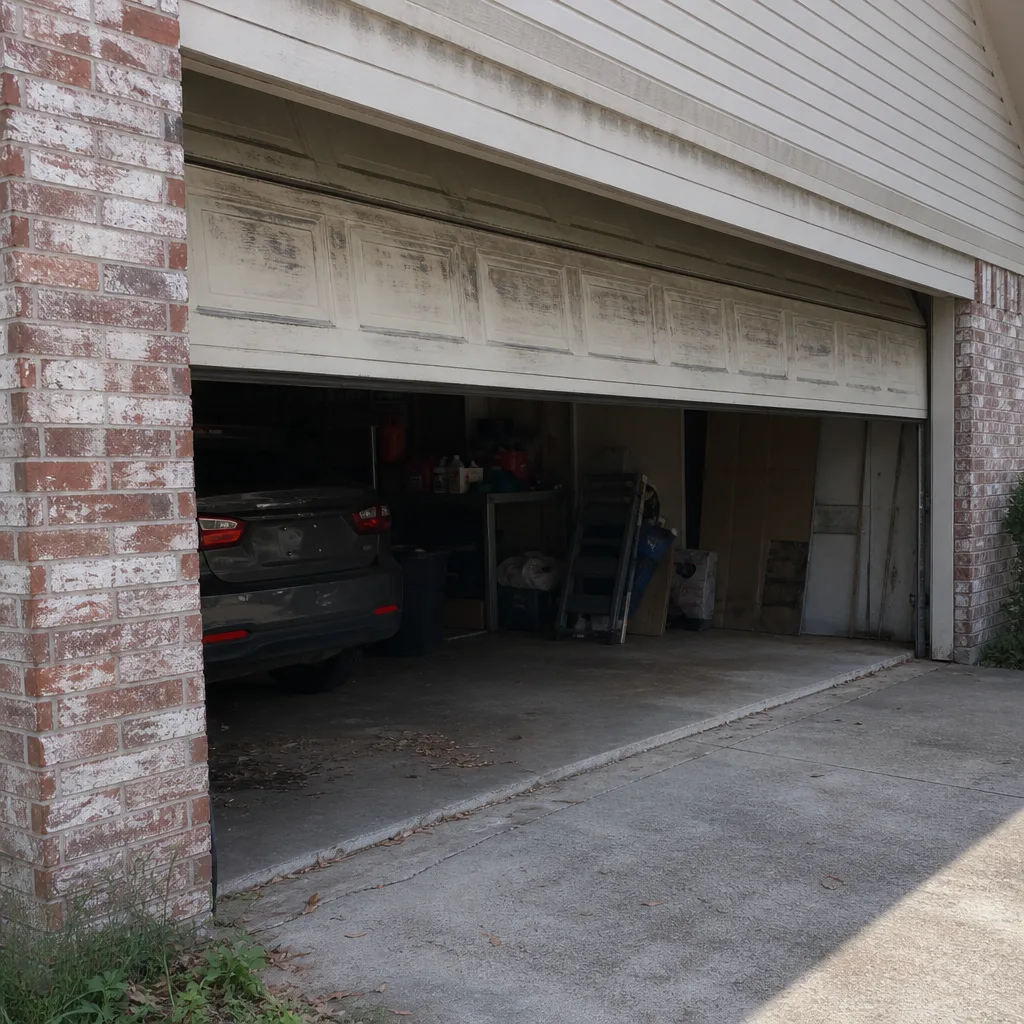 Before
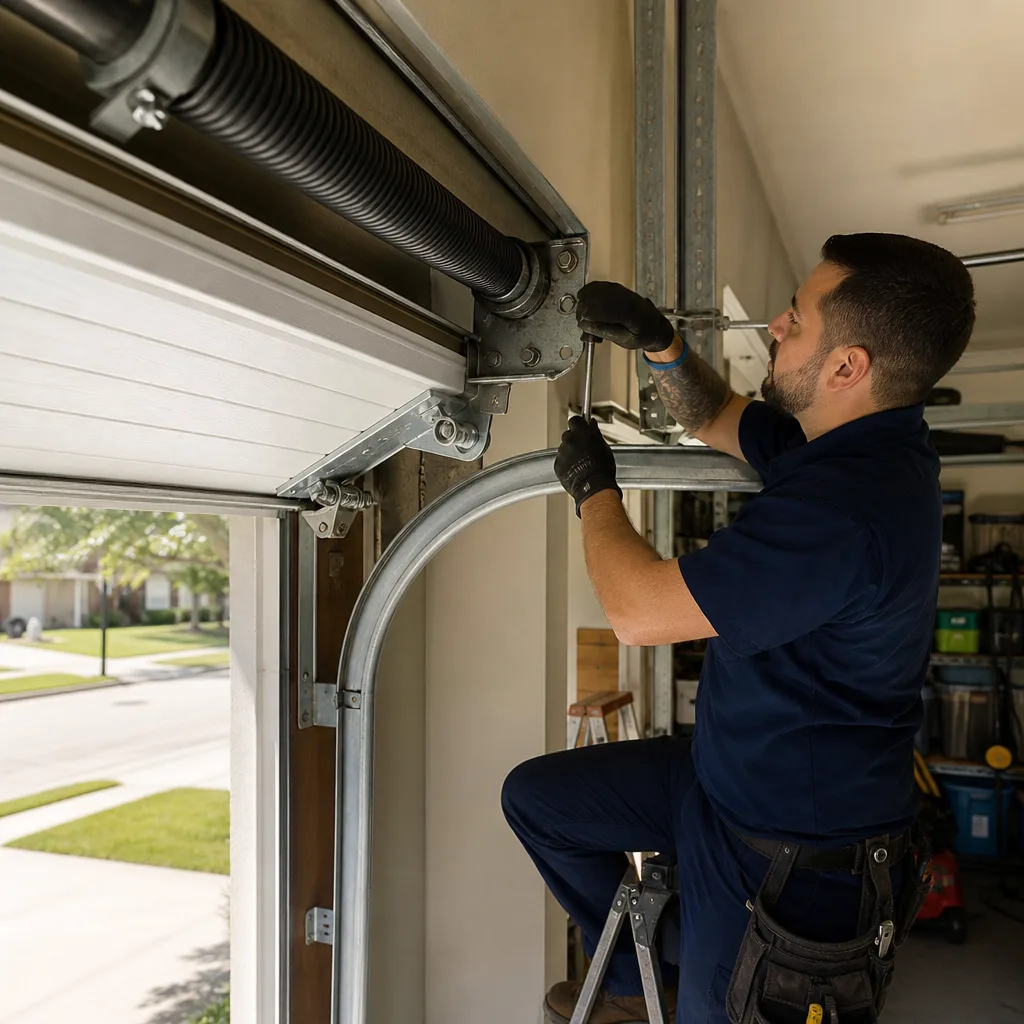 After
After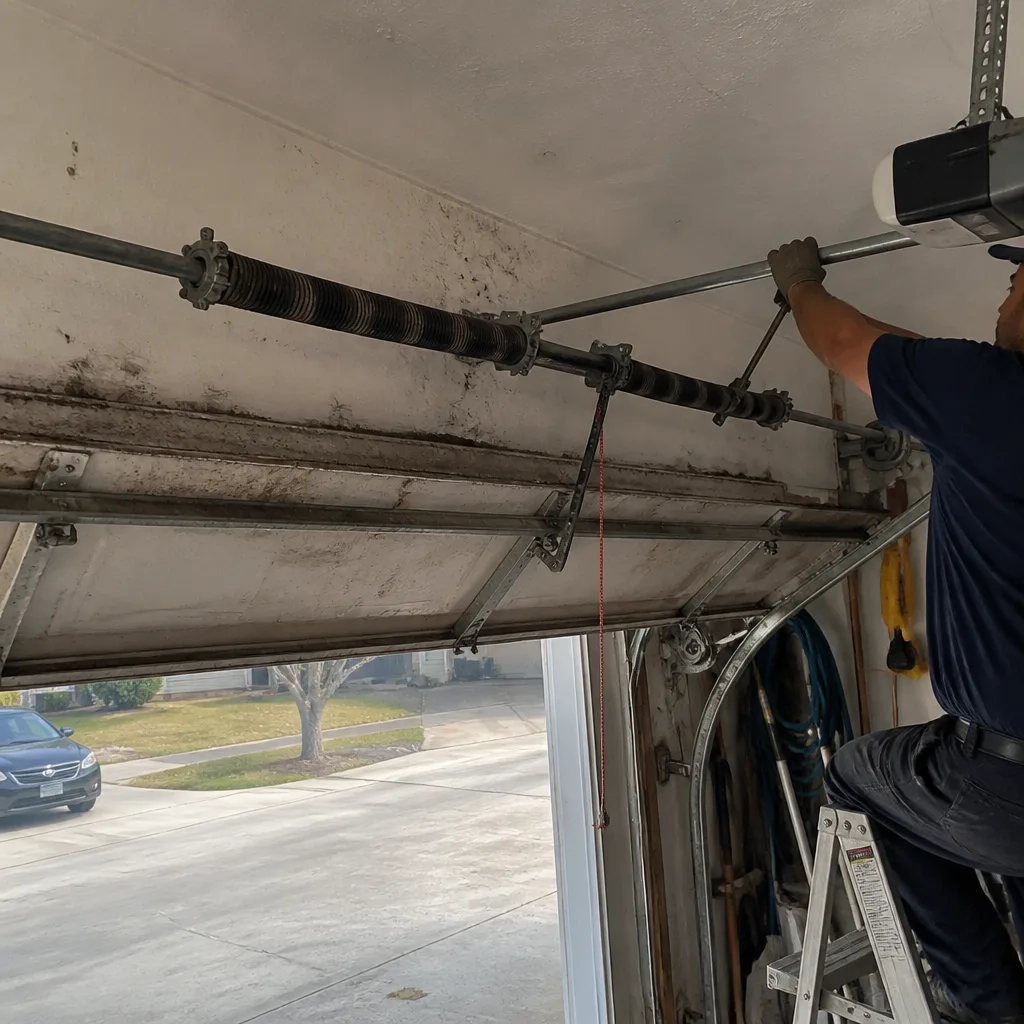 Before
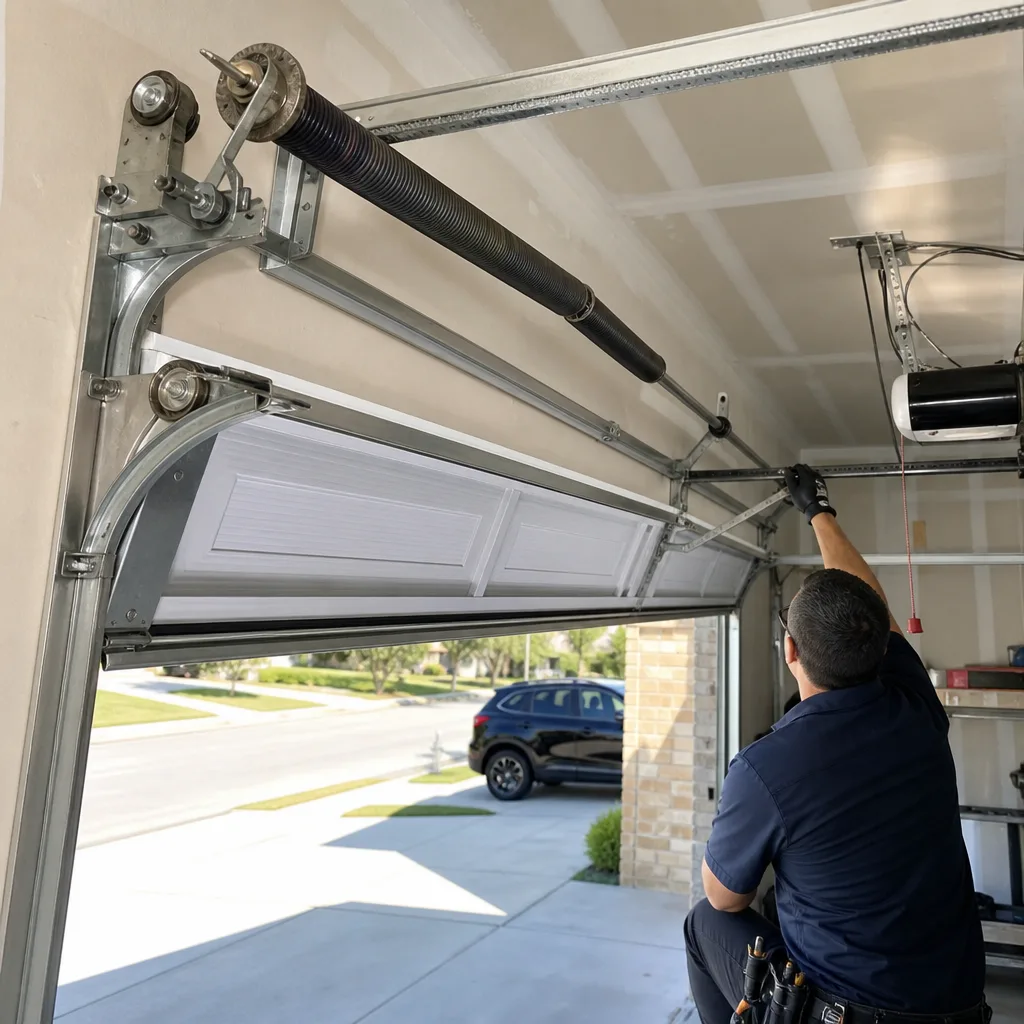 After
AfterGarage Door Warning Signs: A Liberty Homeowner’s Reference Guide
A snapped torsion spring will stop your door mid-cycle and leave a car trapped in the garage. A worn roller will do the same thing, about eight months from now. Most garage door guides list symptoms without telling you how urgent each one actually is, so a homeowner in Liberty treats a slow door the same as a popping cable because no one told them those are two completely different risk levels. This guide ranks warning signs by real danger, not by how alarming they sound. By the time you finish, you will know what to drop everything for, what can wait until Tuesday, and what is just an old door making old-door noises.
Quick Answer
The garage door warning signs that demand immediate attention in Liberty are a snapped or fraying cable, a visible crack in a torsion spring, or a door that drops fast when released from the opener. These are stop-using-the-door-now problems because the door is 200 pounds riding on two springs, and when one lets go, the other follows within days. Everything else, grinding rollers, a slow response, a sagging seal, can be scheduled within the week or logged and watched without putting anyone at risk.
Table of Contents
- Tier One: Stop Using the Door Right Now
- Tier Two: Schedule Within the Week
- Tier Three: Watch and Log
- The Sound Library: What Grinding, Popping, and Squealing Actually Mean
- Visual Signs Liberty Homeowners Miss
- Liberty Humidity and Rust: How It Presents Differently From Mechanical Wear
- The Opener Is Masking a Door Problem (And Why Fixing the Opener First Is Backward)
- Common Mistakes to Avoid
- When to Call a Professional
- Frequently Asked Questions
- The Bottom Line
A Note Before You Read
I am Otto Reinhardt. I have owned and run Otto’s Garage Door in Liberty since 2004, which means I have seen every warning sign this guide covers, most of them on doors within twenty minutes of my own driveway. A door is 200 pounds riding on two springs. Respect it. I wrote this so you can tell the difference between a $200 repair you can schedule next week and a spring that is going to snap at nine o’clock on a Saturday night with your truck inside. If you are ever not sure which one you have, call me. A live person answers, and that person is often me, and I will tell you straight what you are dealing with.
Tier One: Stop Using the Door Right Now
These are the signs that mean the door is no longer safe to operate, full stop. Not “keep an eye on it,” not “let me finish this week and call someone Friday.” Stop. Unplug the opener if you have to, and call a professional. In Liberty, where most homes use the garage as the primary entry point, a door that fails at the wrong moment traps a vehicle and blocks the way out. In our experience, every one of these signs is a same-day job when we see it, because the door can come down hard and the consequences are not theoretical.
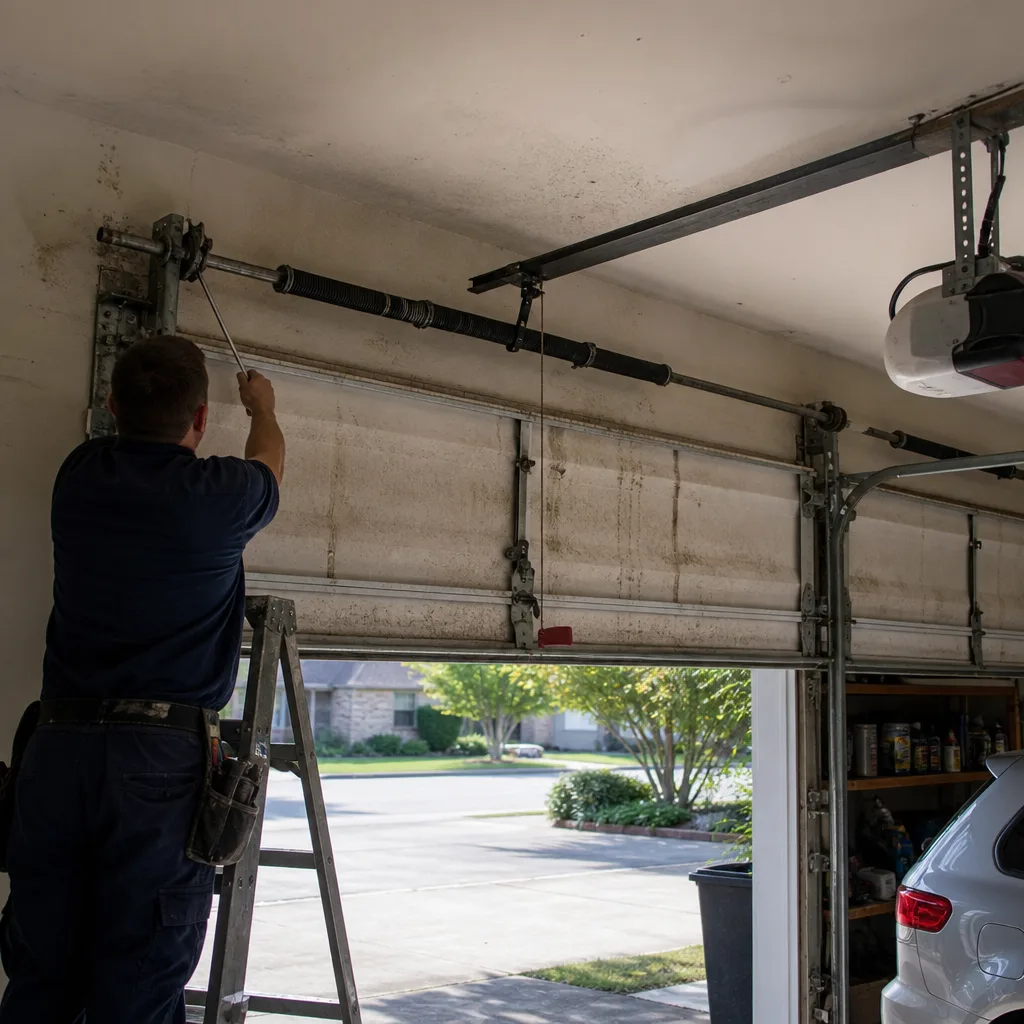
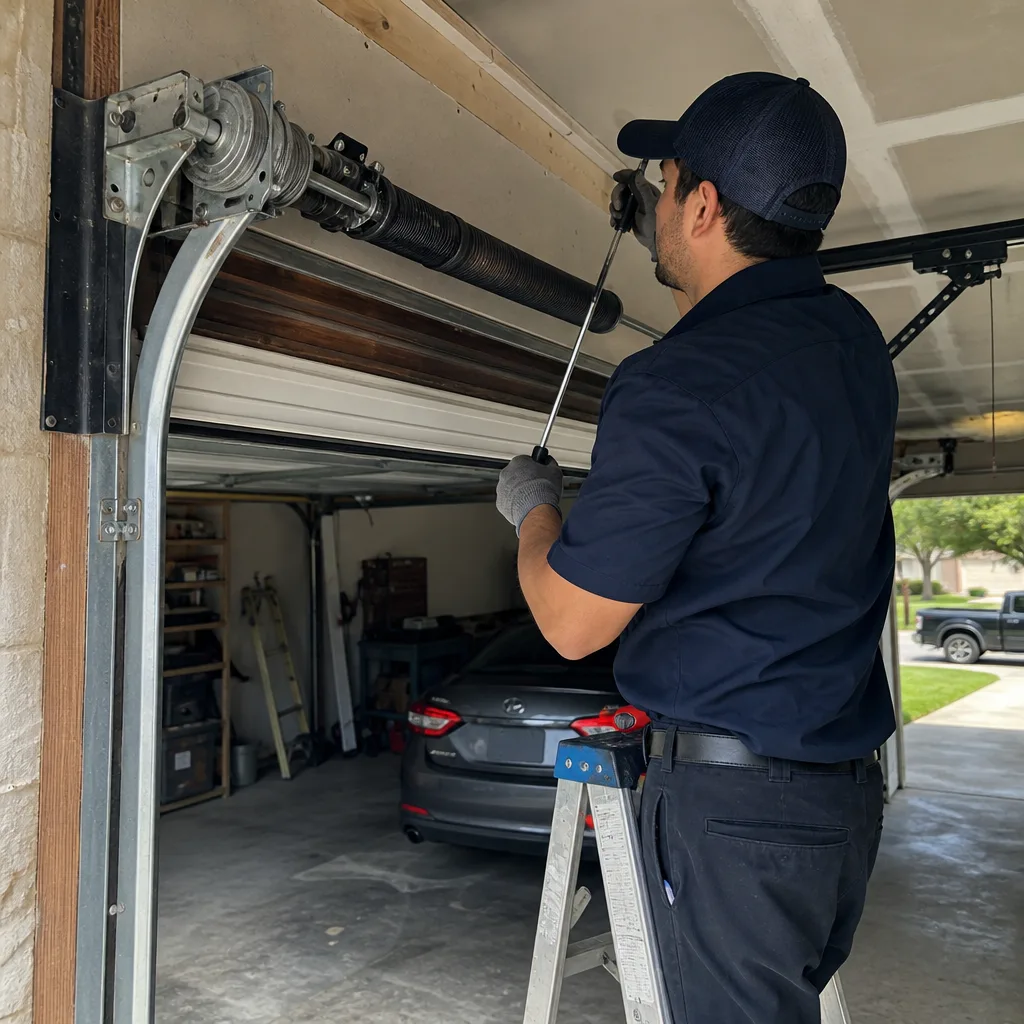
You see a visible gap in a torsion spring. Torsion springs are the coiled steel bars above the closed door. They are under enough tension to lift two hundred pounds, which means when they break, they break violently. A visible gap, a stretched-out coil look, anything that is not a solid continuous spiral, means the spring has already failed or is about to. The door is being held by whatever is left, and that is not a plan.
You see fraying or individual broken strands on a lift cable. The cables run alongside the door and connect the springs to the bottom brackets. A cable with one snapped strand looks like a rope starting to unravel. It is. The remaining strands are carrying the same load with less material. When the cable goes, that corner of the door drops, the panel twists, and the door can come off the track. A falling garage door is not a dent in the car. It is a hospital visit. This is the single most dangerous failure we see in Liberty homes, and it almost always starts with a frayed cable that someone noticed and ignored.
The door drops fast when you pull the emergency release. Pull the red handle that disconnects the door from the opener. The door should stay put, move slowly with your hand, and hold where you leave it. If it drops to the floor, the springs are not doing their job, and every cycle you run is the opener straining against a load it was never meant to carry alone. The opener is not a spring. It will burn out, and more importantly, when the door is disconnected and the spring finally lets go, no opener brake is there to catch it.
You hear a loud bang from the garage, like someone dropped a bowling ball inside. That is a torsion spring snapping. The door will not open. The opener will sit there and grind because it cannot lift the weight alone. Do not try to manually force the door up. Call someone who does this for a living. This is the call we get at nine at night, and the person on the other end is often Otto, and the price quoted on that call is the price on the invoice, because that is how we have done it since 2004.
The bottom roller has popped out of the track. Look at the bottom corner of the door on either side. If the roller wheel is outside the vertical track, the door is riding on three rollers instead of four. It may still open. It may make a terrible noise doing it. Every cycle is bending the track, stressing the other three rollers, and putting lateral force on the panel hinges. This is a door that can bind, jump, and come down sideways. Liberty homes with older Wayne Dalton or Craftsman doors see this more often because the original hardware was lighter-gauge than what we install now.
Tier Two: Schedule Within the Week
These signs are not immediate emergencies, but they are the door telling you a repair is coming whether you schedule it or not. Waiting turns a $50 roller replacement into a $400 panel realignment. These are the repairs we book Tuesday morning when a Liberty homeowner calls us on a quiet Monday, and by Friday the door is running quiet again. For most of these, our advice is to call for a Garage Door Repair in Liberty visit before the problem shifts into Tier One.
The opener runs but the door moves slowly, hesitates, or pauses mid-cycle. A healthy door opens in eight to twelve seconds, steady as a metronome. A door that moves like it is pushing through mud is usually a door problem, not an opener problem. The springs are tired, the rollers are dragging, and the opener is working harder to compensate. The motor is not weak. The load is heavy. More on this in the section below about the opener masking door problems, because this is the single most misdiagnosed sign we correct in Liberty.
Grinding or chattering that comes from a specific spot on the track and is worse at a certain point in the cycle. That is a roller with a flat spot or a bearing grinding instead of rolling. The roller still works. It is eating the track while it does. Every cycle files metal off the track, and one day the roller will jam. Replacing a roller is quick and inexpensive. Replacing a damaged section of track is not, because in Liberty, where summer humidity sits on steel like a damp shirt, a scored track will start rusting inside a season.
The door sits visibly uneven when closed. A half-inch gap on one side, a slight tilt you can see from the driveway. The door has settled; one spring is carrying more load than the other, a cable has stretched, or a bracket has loosened. It still works, which is exactly why people ignore it. An uneven door is working twice as hard on one side, and that side fails first. Level the load now, or replace the spring later. It is a simple trade.
You can hear rubbing or scraping on the outside weatherstripping or see daylight at the top corners when the door is closed. The door has shifted in its track alignment. Left alone, the panels start scraping frame, the hinges start binding, and the seal wears through, which lets warm humid air into the garage all summer. In Liberty’s climate, a garage door that does not seal is a standing invitation to rust and mice, and the fix is a track adjustment, not a new door.
The door shudders or vibrates enough that you can hear it inside the house. This is usually worn hinges, loose bolts, or rollers that are no longer round. The door is literally rattling itself apart. Hardware failures follow. A hinge pin that falls out while the door is open becomes a panel hanging at an angle, and that is a Tier One problem created by ignoring a Tier Two noise.
Tier Three: Watch and Log
These are signs that deserve attention but not anxiety. Log them. Note when you first saw or heard them. Check again in a few weeks to see if they are changing. If they are stable, keep living your life. If they are progressing, move them up the list. This is how responsible Liberty homeowners manage an aging door without getting talked into work they do not need yet. We would rather tell you, “That is normal for a door this age, keep an eye on it,” than sell you a roller you did not need. Otto is a palindrome: reads the same from either end, same as the door. The trust runs both ways.
A steady, high-pitched squeal while the door moves. This is usually dry metal-on-metal contact, most often at the hinge points or roller axles. It is annoying, it is loud, and it is not dangerous by itself. A spray of white lithium grease on the hinge pins, not the tracks, not the rollers, just the hinge pins, quiets it down. If the squeal persists after lubrication, the hinge is worn and will need replacement eventually, not urgently.
Light surface rust on hardware, springs, or track edges. Every steel garage door in Liberty rusts a little. The humidity here is a fact, not a failure. Surface rust is cosmetic. It becomes a problem when it is flaking, pitting, or concentrated on the spring coils and cable drums. Watch it through one wet season. If it is spreading, call someone. If it holds steady, it is just age.
Small gaps under the bottom seal that were not there last year. The vinyl or rubber sweep on the bottom edge compresses over years. A small gap lets in a little moisture, a little dust, maybe a curious ant. It is a maintenance item, not an emergency. Replace it when it bothers you. If the gap is wider on one side, that is a leveling issue, which moves it to Tier Two.
Fading paint or finish on panels, especially the south-facing side. Liberty sun is relentless on Clopay and Amarr doors with older finishes. Fading is cosmetic. It does not affect the door’s function. If the paint is peeling to bare metal, address it before rust sets in, but that is a weekend project, not a service call.
The opener remote works from 20 feet away when it used to work from the street. This is usually interference, aging remote batteries, or an LED bulb in the opener emitting noise on the same frequency. It is not a door problem. Try fresh batteries first. If it persists and the opener is older than ten years, the receiver board is wearing, and the fix is a decision for later.
The Sound Library: What Grinding, Popping, and Squealing Actually Mean
Garage doors talk, and most of what they say is specific. The problem is that guides like this one historically lumped everything into “unusual noise,” which tells you nothing. In Liberty, where garages are used as workshops half the year, the noises matter more because you spend more time near the door. Here is the library, with the actual diagnosis for each sound.
Grinding, like rocks in a coffee can. This is metal-on-metal contact with no lubrication and no smooth rolling surface. Most often it is a roller bearing that has failed and is now sliding instead of spinning, or a track that has been bent just enough that the roller is scraping instead of rolling. The fix is roller replacement and track inspection. Grinding is a Tier One or Tier Two sound depending on how sudden it is. New grinding that started overnight: treat as Tier One until you know the cause.
Popping or banging that happens when the door changes direction. This is usually a torsion spring adjusting on its mount, common in spring and fall when temperature swings change the metal tension. A single pop when the door reverses is normal. Repeated popping through the cycle, or popping accompanied by a change in how the door moves, is a spring beginning to bind or a cable beginning to ride off a drum. That is Tier One. We have heard the difference a thousand times in Liberty homes, and the second one is a call-before-dark sound.
Squealing, high and steady, like a loose belt. Dry hinge pins, as covered above. This is the least alarming sound a door makes, and the most commonly over-treated one. Lube the hinge pins. Watch it for a week. Most squeals die right there.
A rhythmic thump-thump-thump as the door travels. This is a roller with a flat spot, a section of track with a small dent, or a panel that is slightly warped. The door is hitting the same spot on every cycle. It is Tier Two in most cases, because that flat spot grows with every revolution, and eventually the roller stops rolling entirely.
A sharp crack followed immediately by silence. That is a spring snapping. Tier One, and it is not subtle. The door will not open afterward. The opener will run and nothing will move, or the door will try to rise a few inches and stop. Do not force it. Call someone who has done this work in this county since before half these doors were installed.
Visual Signs Liberty Homeowners Miss
Some of the most important warning signs never make a sound. They are visible, but they look normal until they do not, and by the time they are obvious, the repair is bigger than it had to be. Go out to your garage with a flashlight, put it six inches from each of these spots, and look. Two minutes, once a season, catches most of these early.
Cable Kinking Near the Bottom Bracket
Stand to either side of the closed door and look at the spot where the lift cable attaches to the bottom bracket. If the cable is not running in a clean single line, if it has a slight S-curve, a twist, or a spot that looks pinched, that is kinking. It happens when the door is slightly out of balance and the cable is spooling and unspooling unevenly on the drum. A kinked cable is a frayed cable waiting to happen. This is the visual sign we see most often on older Amarr and Wayne Dalton doors in Liberty, and it is the one that converts a $90 cable replacement into a $600 panel-and-track repair when it snaps.
Bottom Seal Gaps That Change With the Weather
The rubber sweep along the bottom edge compresses in cold and expands in heat. Most Liberty homeowners look at the gap in January and think the door has shifted, then ignore it in July when the gap closes. Here is what actually matters: if the gap is uneven, wider on the left than the right in any weather, the door is not level. That is Tier Two. If the gap is even and uniform, it is just a worn seal, and seals are $30 maintenance items you can schedule whenever. The distinction is not about the gap. It is about the evenness, and no one tells you that.
Panel Corner Separation
Look at the corners of each panel, where the horizontal seam meets the vertical edge. On older doors, especially Craftsman doors from the early 2000s, the corner brackets that hold the panel face to the side rail can work loose. You will see a small triangular gap, maybe an eighth of an inch, that grows over months. The door still works, which is why it gets missed. But that loose corner is a hinge under stress, and when the hinge lets go, the panel folds. On a door that gets cycled twice a day, that failure comes faster than anyone expects.
Track Bolts That Have Backed Out a Quarter Inch
Run your eyes along the vertical tracks on both sides, looking at every bolt head. A bolt that has backed out even a little leaves a shadow gap between the bolt head and the track. Grab a wrench and snug it down yourself, this one is genuinely safe and easy. But if the same bolt backs out again within a month, the track is moving under load, which means the door is out of balance. The bolt is the symptom. The balance is the problem.
Grease Streaks on the Spring Coils
From a distance, a torsion spring covered in dark streaks looks dirty, and most people never look at it at all. Up close, those streaks are a sign the spring has been working under uneven load, usually because the other spring is failing, or because the door was installed with mismatched springs. The grease is not leaking out; it is being squeezed out. A spring that has squeezed its lubrication out is running hotter than it should, and hot springs fatigue faster. If your springs are streaked, call for an inspection before the next season change.
Liberty Humidity and Rust: How It Presents Differently From Mechanical Wear
This section matters for Liberty in a way it would not matter for a homeowner in Arizona. Our humidity averages over 70% most months, and East Texas air sits on steel. Garage door hardware rusts here. It rusts on doors that never gave anyone a day of trouble. The trick is telling rust from actual wear, because the treatment is different, and treating rust like wear is how you get sold a spring replacement you did not need.
Surface rust on springs looks orange-brown and dusty. You can rub it with a finger and a little comes off on your skin. It is evenly distributed, mostly on the exposed surfaces. This is normal for Liberty. Springs can carry surface rust for years without losing strength. The treatment is monitoring, maybe a light wire brushing if you want, and making sure the garage is ventilated. This is not a repair.
Wear fatigue on springs looks different. It shows up as a visible crack, usually fine like a pencil line running across a coil, or a section where the gaps between coils are no longer even, where one coil has settled against the next. The metal may look fine, no rust at all. The fatigue is inside the steel. When you see uneven coil spacing or a crack line, that spring has lost its temper and it is done. The treatment is replacement, not because of the rust but because of the mechanical fatigue, and no amount of cleaning changes that.
Pitting rust on tracks and hinges creates small craters rather than an even dusting. You can feel them with a fingernail. A pitted track will wear out a new roller in half its normal life because the roller is running over a rough surface. A pitted hinge pin is weaker and can shear. The treatment for pitted hardware is replacement of the affected part, not the whole door. This is the distinction that saves Liberty homeowners serious money: localized replacement beats whole-door replacement every time, and a shop that wants to sell you a whole door for a pitted hinge should be asked to leave.
The bottom line on rust in Liberty: if it is even, dusty, and unchanged for months, it is our climate, not a failure. If it is pitted, cracked, or concentrated on load-bearing parts, it is a repair. When we inspect a door, the first thing I do is test the spring tension and check for fatigue cracks. The second thing I do is tell you honestly whether the rust you are looking at matters. Those two conversations are different, and honesty is why people have called us back since before half these neighborhoods were built out.
The Opener Is Masking a Door Problem (And Why Fixing the Opener First Is Backward)
Here is a scenario we have corrected more times than I can count in Liberty. The door starts moving slowly. The homeowner calls a garage door company. That company replaces the opener motor, or the circuit board, or the whole opener unit, for $500 or more. The door runs fine for a month. Then it slows down again. Why? Because the opener was never the problem. The door was heavy, the opener was straining against it, and the new opener is just doing the same thing with fresher parts.
The single most misread warning sign on a garage door is slow response time that comes on gradually over months. A door that used to open in eight seconds and now takes fourteen, with no change to the opener settings, is a door that is getting heavier to lift. The springs are losing their tension, or the rollers are dragging, or the door has come slightly out of balance. The opener is compensating as best it can, and the added strain shortens its life. But the opener itself is fine. If the opener is straining, the problem is almost never the opener.
Here is how to tell the difference without buying anything:
- Disconnect the door from the opener by pulling the red emergency release handle.
- Lift the door by hand to waist height and let go.
- The door should stay where you left it, or drift only slightly.
- If it drops toward the floor, the springs are weak and the door is heavy.
- If it rises toward the ceiling, the springs are overtensioned.
- Either way, the opener is not the problem. The springs and balance are.
If the door holds steady when you release it by hand but still moves slowly with the opener connected, then look at the opener itself, starting with the force settings and the gear drive. But in our experience in Liberty, nine times out of ten, the homeowner who thinks they need a new opener actually needs a spring adjustment or a roller replacement, and the opener will keep going for years once the door is balanced again. A Garage Door Opener in Liberty replacement should be a last step, not a first guess. That is not the order the national chains use, but we are not a national chain. I will be there myself, the name on the van is the name on the invoice and the name on the license, and I have no reason to sell you an opener you do not need because I would rather answer your call in eight years than not.
Common Mistakes to Avoid
- Treating every noise as an emergency, which leads to overtreatment. A squealing hinge and a snapped spring are not the same thing, but a company that wants a big ticket will happily let you think they are. Know the tier system above, and use it.
- Lubricating the tracks or the rollers themselves. Tracks should be clean and dry; grease on the track attracts dust and grit that becomes grinding paste. Lubricate only the hinge pins and the spring coils, sparingly, with white lithium grease.
- Replacing the opener when the door is heavy. This is the most expensive mistake we see in Liberty homes, and it usually happens because a quick-bid outfit diagnoses the symptom instead of the cause. Test the door by hand first, every time.
- Ignoring a frayed cable because the door still works. A frayed cable is the only warning you get before a cable snaps, and a snapped cable is the most dangerous garage door failure there is. If you see even one broken strand, that is a same-week call at minimum.
- Forcing a door that will not open after a loud bang. When a spring snaps, the door may be partially open or closed with a car inside. Pulling harder on the handle or using a pry bar is how people get hurt. Stop, call, and let someone with the right tooling and the right respect for the load handle it.
- Waiting until the door fails completely before calling. Garage doors almost never fail without warning. The warning signs are all listed above, and a Liberty homeowner who calls at the Tier Two stage spends a third of what the Tier One emergency costs. I count spring cycles the way you count tire miles; I will tell you what is left on yours if you call before it is zero.
- Assuming rust means replacement. In our climate, surface rust is normal and harmless. Do not let anyone sell you a new door because the springs look dirty. Ask them to show you the crack, the pitting, or the fatigue line. If they cannot point to a mechanical failure, get a second opinion. Ours is free on any written estimate, no trip charge inside the county.
When to Call a Professional
Call a professional the same day you see a frayed cable, a cracked spring, a visible gap in the spring coils, a door that drops fast when released, or a bottom roller that has left the track. These are not do-it-yourself repairs. A torsion spring is under enough tension to cause serious injury, and the cables that share that tension can snap with enough force to cut. If you are not trained and tooled for that, do not attempt it. Call a pro, and if you are in Liberty, call (346) 496-4718. Otto’s Garage Door offers free estimates for Liberty homeowners, and a live person answers the phone even on nights and weekends. We have been locally owned and owner-operated since 2004, and every job carries the 90-Day Done Right Promise in writing: if it is not done right, we make it right, and one call brings Otto back, no runaround.
Frequently Asked Questions
Look at the spring with the door closed. A spring about to break will often show a visible crack line across a coil, uneven spacing between coils where one has settled against the next, or a stretched-out look in one section. You may also notice the door getting heavier to lift by hand, or hear a popping sound when the door changes direction, and any of those signs in a Liberty home means a same-week inspection is warranted. Call (346) 496-4718 for a free estimate; we inspect the whole door while we are there.
A loud bang when the door changes direction is most often the torsion spring adjusting on its mounting cone, which happens when the temperature changes and the metal expands or contracts. A single bang is usually normal, especially in Liberty during the spring and fall transitions. Repeated banging through the cycle, or banging that starts suddenly and gets worse, is a spring binding and is worth a professional look. The fix is usually a spring adjustment or replacement, and we quote it on the call and hold that price at the door.
We strongly advise against it, and not because we want the work. Torsion springs are wound under enough tension to lift a 200-pound door, and a spring that slips during winding or unwinding releases that energy in an instant. People are seriously injured every year attempting this repair. The safe path is a trained professional with the right winding bars and the experience to do it without drama. We replace springs most weeks in Liberty, and the job is done safely, quickly, and backed by the 90-Day Done Right Promise.
Standard torsion springs are rated for about 10,000 cycles, which works out to seven to ten years for a typical Liberty home where the door opens and closes three or four times a day. High-cycle springs can last double that or more. The Liberty climate shortens spring life slightly because humidity accelerates surface rust, but mechanical fatigue from cycle count is still the primary wear factor. If your door is over eight years old and you are noticing it get heavier or move slower, an inspection now costs less than an emergency replacement later.
A door that opens gradually slower over weeks or months is usually not an opener problem. It is the door getting heavier, which means weakening springs, dragging rollers, or a balance issue. Disconnect the door from the opener and lift it by hand; if it does not hold steady at waist height, the springs need attention. Replacing the opener before the balance is checked is the most common avoidable mistake we see in Liberty garages. Call us for a Garage Door Installation in Liberty consultation if the diagnosis points that way, but first let us check the balance.
No, not inside our home county. We do not charge a trip fee for Liberty homeowners, and we offer a free second opinion on any written estimate you have received from another company. Senior and veteran customers receive a permanent 10% discount, and we offer $40 off any repair over $200. The price quoted on the phone is the price on the invoice, always, and it is agreed before any work starts so there are no surprises at the door.
The Bottom Line
Garage doors fail the same way Liberty summers get hot: gradually, then all at once. The difference is that a door almost always tells you first, and now you know the language. A frayed cable or a cracked spring is a stop-everything emergency, and the longer you wait, the bigger the repair and the higher the risk. A slow door, an uneven seal, a grinding roller; those are next-week calls that keep a small repair from becoming a big one. A squealing hinge and a little surface rust; those are watch-and-log items, not reasons to panic or to pay for work you do not need. The whole point of this guide is to give you back the judgment that a quick-bid, read-from-a-script outfit will not offer. If you are ever unsure which tier you are in, call (346) 496-4718 and ask. I answer the phone, I will tell you straight, and the price I quote is the price you pay.
Written by Otto Reinhardt, Owner at Otto’s Garage Door, serving Liberty since 2004.